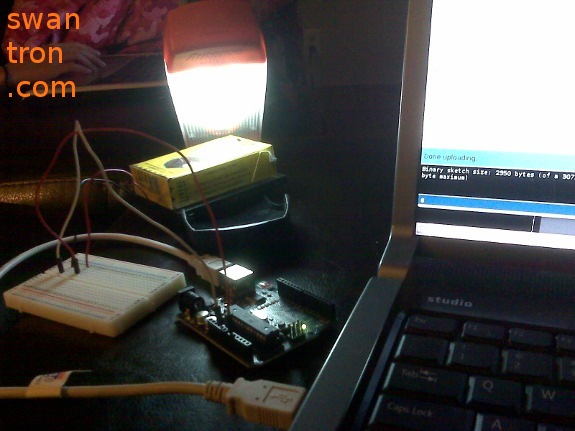
Here we go. As I mentioned a few days ago, I’m horsing around with analog input to my Arduino, in the form of input via a solar cell. For the win. It turns out, that I’m getting far better with my casual electronics experimentation…I will chalk this one up as a win…My basic set-up is this…Radio Shack solar cell, breadboard, florescent light source, Arduino, and a notebook.
Step 1: Gauge light source via multimeter
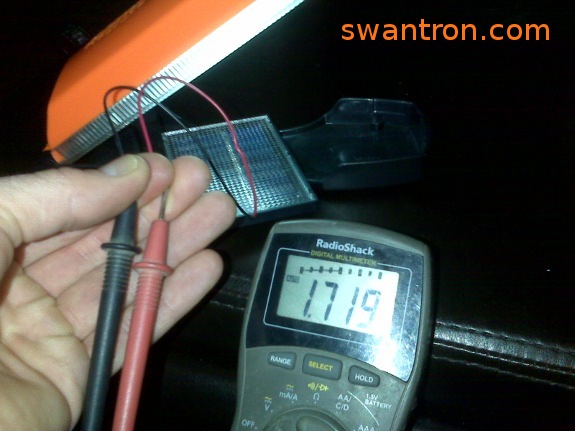 1.7 V…no need to toss in a resister, as the Arduino can handle 5V without issue. Good to go.
Step 2: Interface with Arduino via breadboard
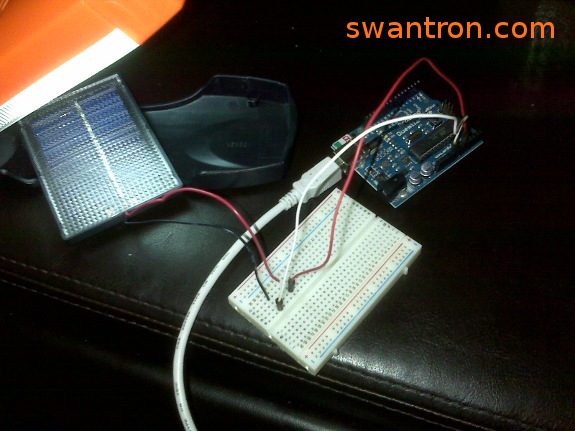 This could have been a direct setup, but for the sake of not soldering a solid lead to my solar cell array, I chose to twist the crap out of the existing + and - leads of the wire outs on the unit, and cram them into the breadboard. USB connected to the Arduino, of course.
Step 3: Chop in some code for the Arduino
This was the tricky part…not that tricky, however:
void setup() {
  Serial.begin(9600);
}

void loop() {
  int v = analogRead(0);
  Serial.print(v);
  Serial.print(' ');
  delay(900);
}
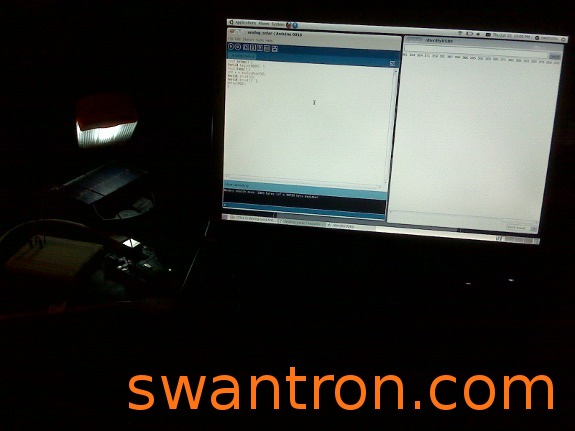
Note the lack of comments? I’m a flipping math dude, so that is wholly optional in my book. Long story short, Wiring is a stripped cousin of C++…I have to void setup and loop here, since I am not concerned with anything once I let ’er rip. I will touch on the programming specifics at a later date, but inquiring minds can find this info quite easily on the Arduino project’s main page, or on Wikipedia. Knock your socks off. I added the delay for sake of real-time monitoring, and matched the baud rate to which I had configured my USB connection. ttyUSB0 would be that in question…9600 would be the rate.
Step 4: Read input via serial monitor
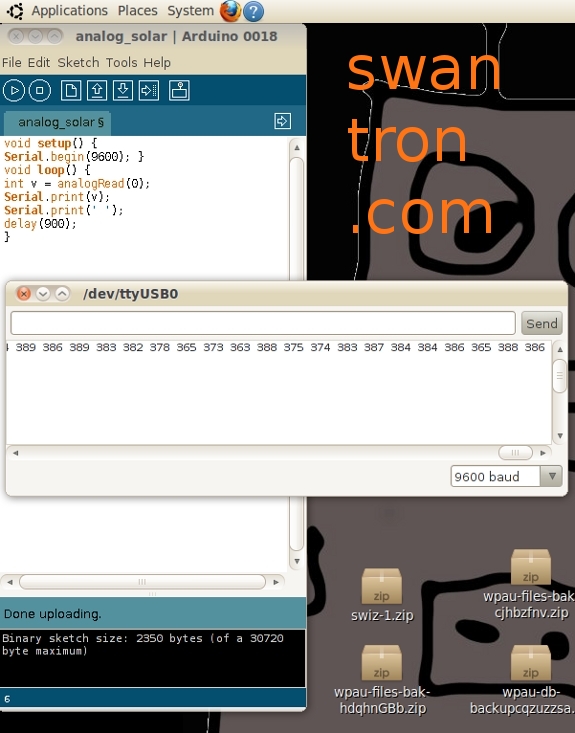 As you can see, it is pretty much constant, with some fluctuation due to my set-up. Noisy, yes. Cheap components, yes.
Step 5: Testing ‘zero’ state
Here, I have employed my box of smokes. American Spirit Lights, to be precise.
Step 6: Gauge system
Here, I’m altering between ‘on’ and ‘off’ states. I start with the ‘off’ (smokes on solar panel) configuration for a time, remove the box to open the system to ‘max input’ for appx 7 secs, and then place the box to remove the input energy.
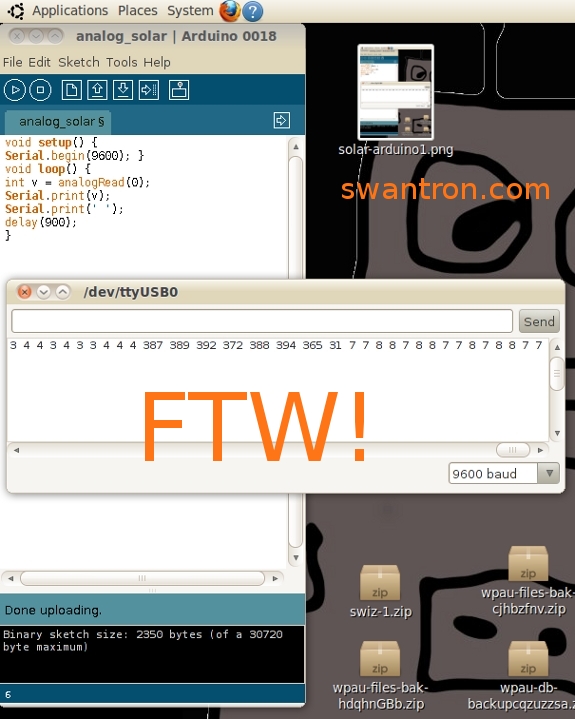
Most definitely for the win…with the experimental noise, that could be considered effectively zero. For the win. In summation, I have read in analog, as intended. Lessons learned? Pretty straight forward I suppose. My cheap-o solar cell is rated for a max of 6V, which I was far under. If I was to use this setup with a stronger light source, I would need to take this into consideration. I didn’t perform any data transformation, as I was not concerned with ‘actual voltage input values’ in this case…merely relative. Most importantly, I was able to knock out the task I had set out to do. Hopefully, I can ride my EE high and get cranking on something awesome, like a netbook robot. With some lasers.