We’re off this week for fall break. No school, no work, a fridge full of Thanksgiving stuff. A good week to finally shackle all the house automation junk together into something cohesive.
Count the apps it takes to run this house. Google Home for the thermostat and cameras. LG ThinQ for the washer and dryer.. which live on Katie’s account, so that’s a share request. SmartThings for the fridge. Tailwind for the garage. A printer that’s somehow always low on magenta.
I wanted one page. Open it, see the house, close it.
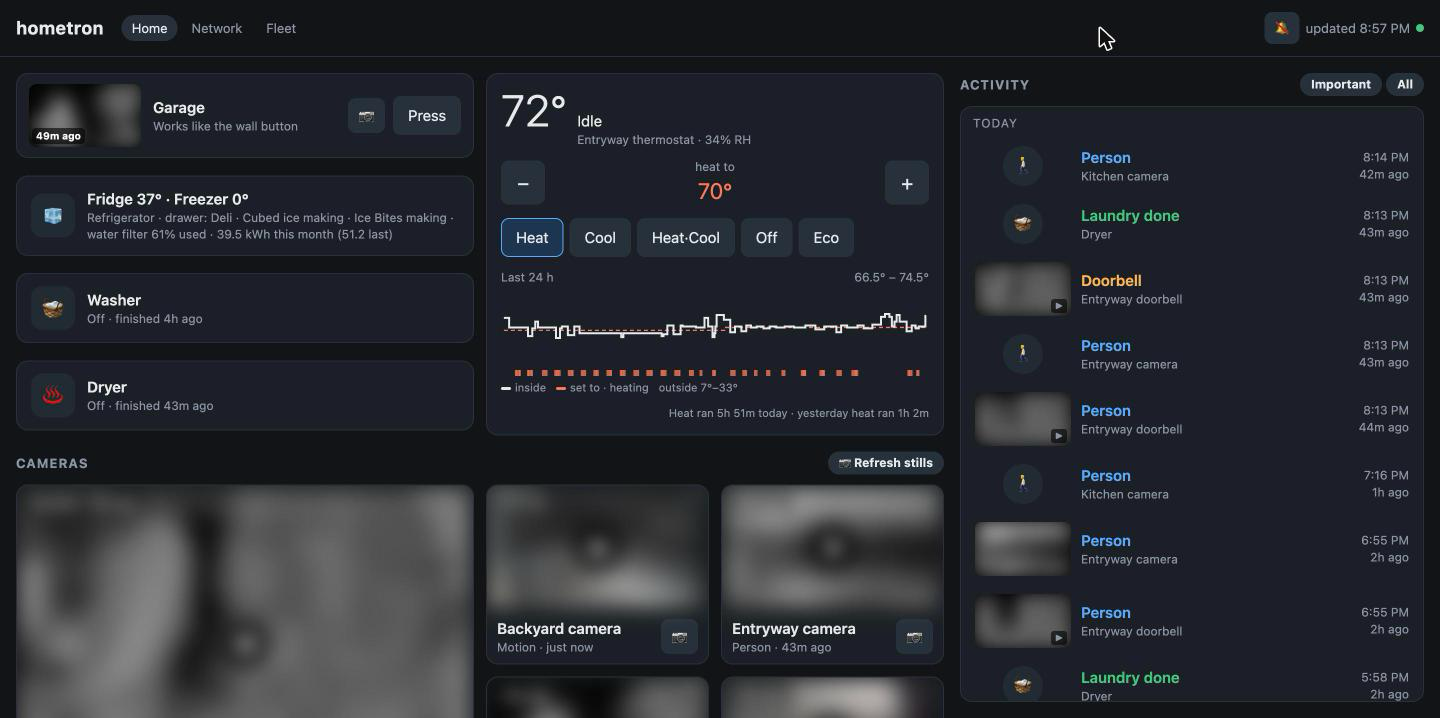
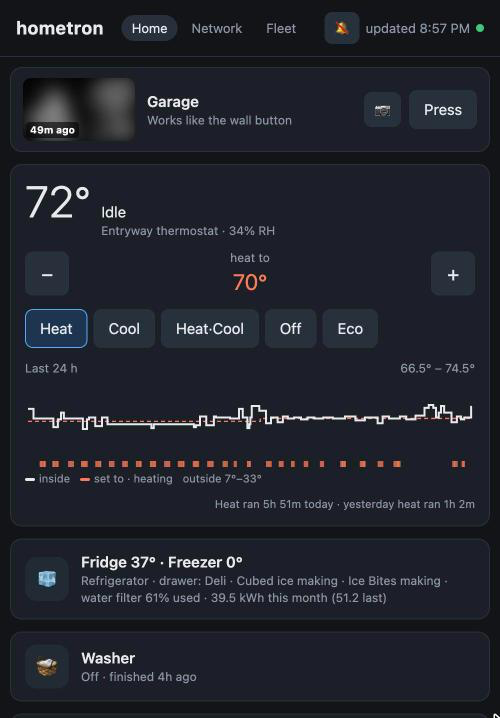
The camera shots are blurred on purpose. You don’t need a tour of my yard.
Where to Run It
The obvious answer is Home Assistant. The obvious place to run it is a Raspberry Pi.
I didn’t want to buy and babysit a Pi. And I already had a box: an old M2 MacBook Air, lid shut in a closet, already on Tailscale as a little always-connected server. 8 GB of RAM, sleep turned off, logs itself in after a power blip. It was sitting there doing nothing.
So I tried Home Assistant OS in a VM on the M2. Then I was clicking through VM setup dialogs over Screen Sharing on a Sunday afternoon, and I quit. I don’t need ten thousand integrations. I need about six.
So I wrote one: hometron. One Go binary on the M2, only reachable over Tailscale. It never touches the public internet.
The Garage Door
The garage was the thing I actually wanted most, and it fought the hardest.
The opener is a Chamberlain, and Chamberlain’s MyQ API is closed to third parties. So there’s a Tailwind controller on it, which has a local API.. no cloud needed. Great.
Except it always said the door was open. Every time, with the door closed. It wouldn’t close it from its own app either. Wiring checked out, the opener and remotes were fine. Off to Tailwind support.
The postmortem: their firmware was reading the opener’s digital output as analog. Support pushed a fix to the controller remotely, and it started behaving. Not something I was going to find on my end.
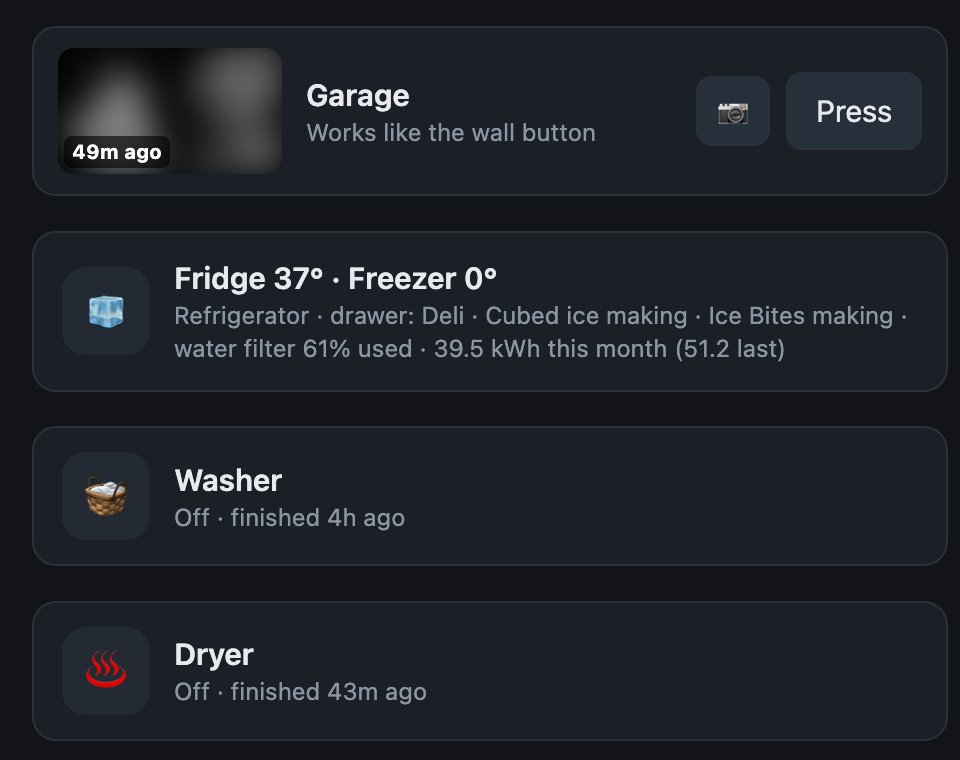
MyQ has a door sensor and knows whether the door is up or down.. but that lives behind the same closed API, and the Tailwind doesn’t have a sensor of its own on this door. So the card doesn’t pretend to know. It shows a still from the garage camera next to a button that works like the wall button. Look, then press.
Building It Out
Once the garage worked, the rest snowballed.
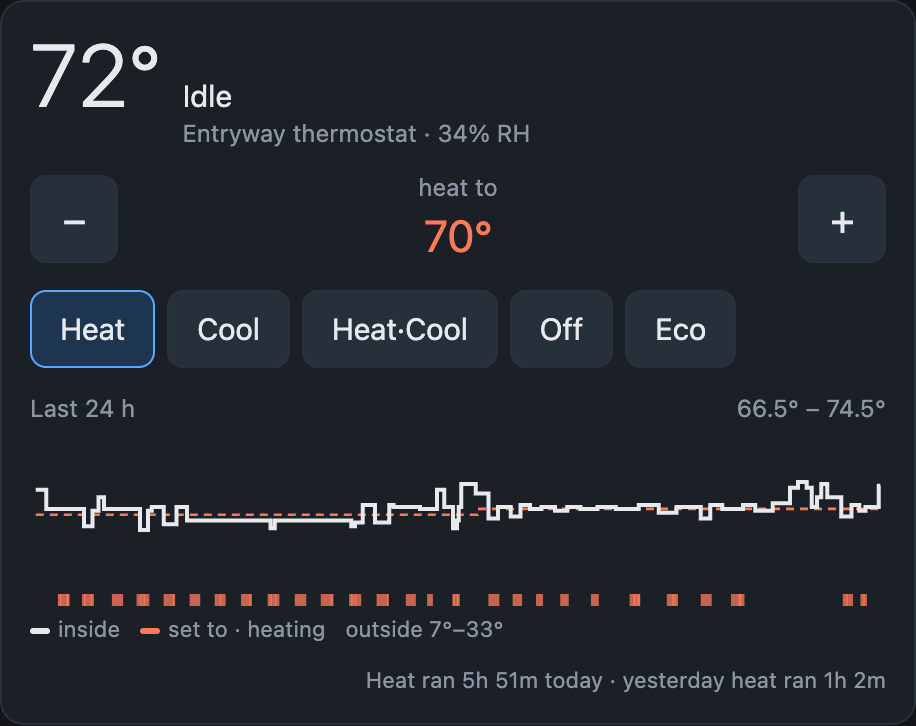
- Thermostat. Set it, flip modes, and a 24-hour chart of inside temp vs. setpoint vs. outside. “Heat ran 5h 45m today” settles more arguments than you’d think.
- Cameras and the doorbell. Live view, plus a feed of who showed up, when, with a picture. The doorbell rings the kitchen speaker too.
- Washer and dryer. What’s running and how long it has left. Leave a load in the washer for an hour and the kitchen speaker says so. Not after 9 pm, though. Nobody needs to be scolded about laundry at 10:30.
- Fridge. Temps, door alerts, water filter life, how many kWh it burned this month.
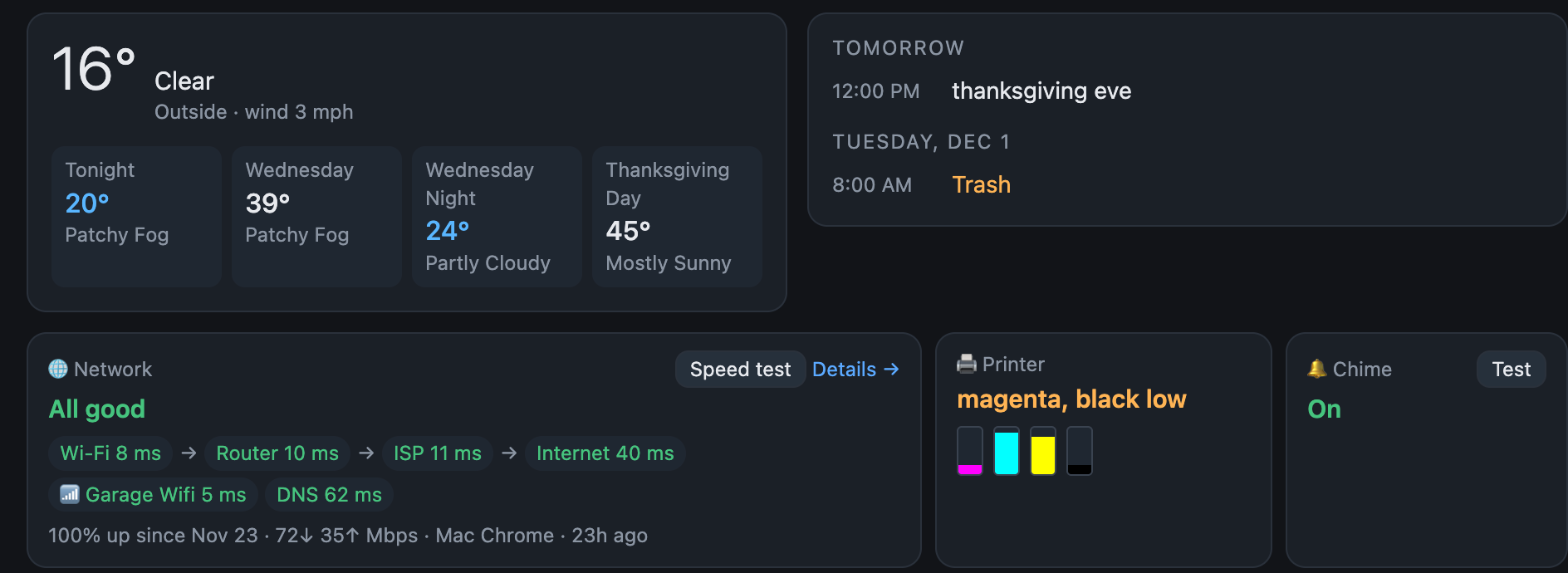
- The rest. Weather, tomorrow’s calendar, trash night, printer ink, and whether the internet is actually down or it’s just the Wi-Fi.
Most of the build was arguing with vendors, not writing the page.
Pictures. Google’s Device Access API sends a “person” event for most of my cameras with no picture attached. Those cameras do live video over WebRTC and that’s it. A “person” event with no person in it is pretty useless. So the server keeps a headless Chrome open on its own dashboard. When a person event comes in, that hidden copy opens the live stream, grabs a frame, and hangs it on the event. Weird, but it works. (Until Chrome decided a page nobody can see doesn’t need to do anything, and quietly skipped every person for a couple hours. Fixed.)
The fridge. Samsung started charging for SmartThings API apps this month. The free path is a personal token that expires every 24 hours. So hometron keeps a browser on the server signed in to SmartThings and mints itself a fresh token every day. Samsung logs that browser out anyway, so someone signs in about once a day. The fridge card warns you a day ahead. I’m not paying $5 a month to watch my fridge.
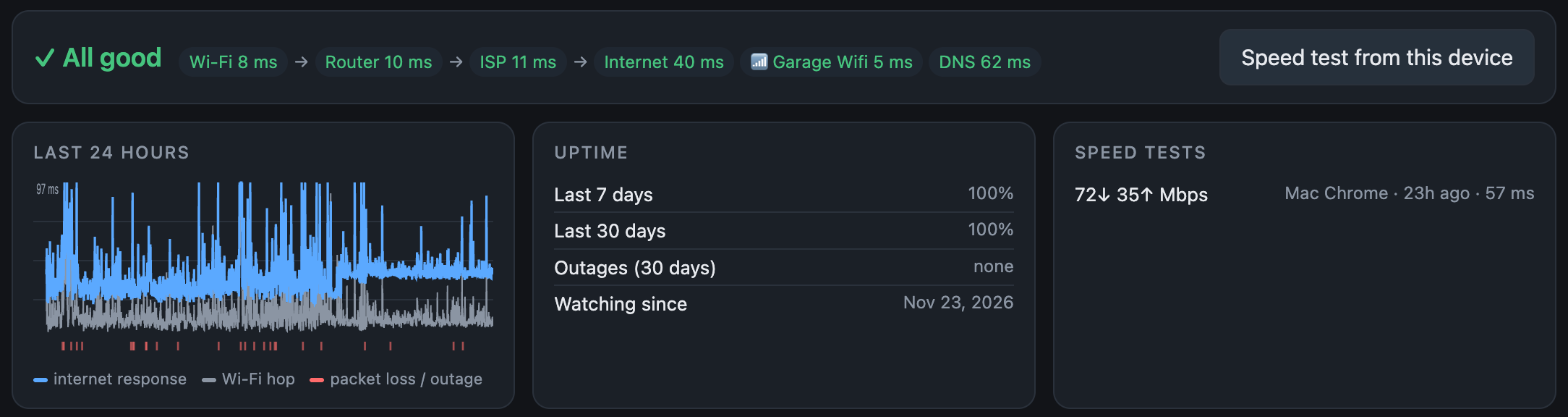
The Wi-Fi. Turns out the Google Wifi was quietly NAT’ing every Nest device onto its own network, so the server couldn’t see half the house. Moved the M2 over. Now it pings every hop out to the internet once a minute, and outages show up on a strip instead of as “is it just me?”
Then the Cloud Bills
With a dashboard already up, I bolted on the other thing I never look at: what I’ve got running in the cloud and what it costs me.
I sort of wound up with a fleet. A bunch of stuff on DigitalOcean, a bunch on Google Cloud, eleven domains at Squarespace, Google Workspace for the family. Claude and Cursor are flat $20 a month each, so those are just typed in. The rest gets looked up:
- DigitalOcean gives up everything with a read-only token.. apps, droplets, volumes, the month-to-date bill.
- Google Cloud gets walked project by project: Cloud Run, VMs, buckets, image repos, Firebase Hosting, and which APIs are switched on.
- Domains get their renewal dates from RDAP, and the DNS gets matched up to whatever is actually hosting each one.
- Workspace shows who has a seat, when they last signed in, and who doesn’t have 2-step on.
- Every site gets hit once a minute, with an alert if a cert or a domain is about to lapse. The same idea as watchtron, just from my closet.
I’m less worried about the spend than about the inventory. So the useful part is a short list at the top: kill, trim, check. First pass found two Google Cloud projects with nothing in them, an image repo sitting on 2.3 GB of old builds, and an app on DigitalOcean running two “professional” instances for a personal site. Time to go delete some stuff.
The Stack
Go, standard library only. One binary, no frameworks, no npm. It cross-compiles on my laptop and make deploy drops it on the M2 as a launchd service. The web side is one HTML file. Push notifications, the Chromecast protocol, the DevTools client that drives Chrome.. all hand-rolled. That’s part of why it’s ~13k lines, but there’s nothing to npm audit at 2 am.
Phones can pin it to the home screen.
Worth It?
Yeah. It’s the tab I leave open. The dryer says 12 minutes left, the doorbell shows who it was, the fridge is 37°, and nothing in the cloud is quietly billing me.
Not bad for fall break.
Source: github.com/swantron/hometron
It isn’t a product. It’s wired to my house. But if you’ve got a Nest thermostat and a closet with an old laptop in it, steal whatever’s useful.