I’m writing this post on the road. Opera Mini is what it is… It certainly is not a blogger’s smoothest means of posting content. That said, another day another dollar; there are paid posts to write. Like this guy about Kodak cameras.  The posting tool isn’t optimum, but the timing is right. We made it to Helena without our trusty easyshare digital camera. I should say the ‘we’ with a disclaimer, since it is a bright pink Kodak Easy Share. Color aside, I love the thing. The picture quality is super, and the user interface is super easy to use to boot. I’d you haven’t tried Kodak cameras in the past few years, you should give one a shot before buying another brand. They really have focused on usability instead of the bells and whistles, and have the best easy-to-use product on the market. They still have the features that the average consumer wants, but leaves out the type of additional stuff that is largely unused by most. Check one out. They are fairly inexpensive now, and give you a ton of bang for your buck.
Stellarium on Ubuntu
It has been too long since I have sang the merits of Ubuntu. Meerkat is great. 10.10 LTS has been flawless for me, even since the beta, on both my notebooks and my Mini 9 netbook. Anyhow, I have had Stellarium running for some time. I realized I have yet to mention it. Here is the view from my ’laboratory’ from two nights ago: 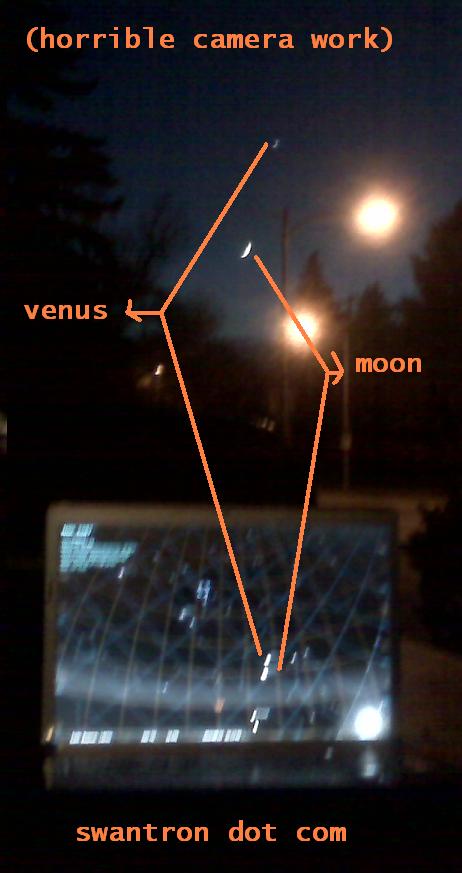 Awful photojournalism. Wanna fight about it? Pictured is the Moon, Venus, the Moon, and Venus…the two former live, and the two latter via Stellarium. Pretty sweet. I have had Stellarium cranked up several times looking at stars, but my BlackBerry is far worse when it comes to photographing stars than it is when photographing planets and the Moon. Check it out…price is FREE.99 via the Ubuntu Software Center. FTW.
Google Apps Chat
I’m all about Google. It is no secret that Android gives me the warm and fuzzies; I suppose that is the root of my affection. As I sit here, looking at my quickly-dying BlackBerry Pearl, I’m counting down the days until I can blog via my HTC Incredible. It will be, undoubtedly, incredible. Especially since I can have the Android holler at my Arduino, and vice versa. My warm and fuzzies just turned into warmer and fuzziers. Enough about that. Today, we are talking Google Apps. Buy into the cloud computing revolution, my friends, as it is upon us. Google is far more than the search engine of times earlier:  If you haven’t received the memo, there now exists Google Apps:
 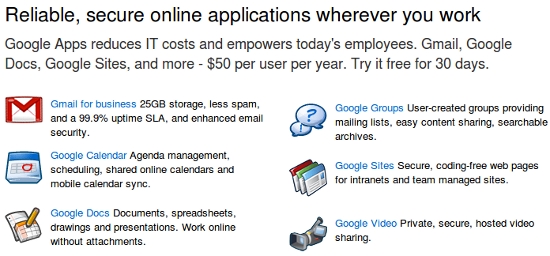 Long story short, Google Apps allows you to free up system space by whisking your info into the clouds. Cloud computing is the future…no need to keep several TBs of data locally, when info can be collected and accessed via an online warehouse. Check out the Google Apps Marketplace, if you don’t believe me. Secure solutions for practically any info that was once married to one particular machine or server. I stumbled across this site, after they asked me to blog for dough about them… Mavenlink is on the cutting edge of the Google Apps scene. Login with your Google ID, and you are given direct integration with Gmail, Google Calendar, Google Sites, et. al. Now that Mavenlink is now integrated with Google Apps, sharing info is easy as whistling Dixie. As far as I can tell, the ease of and subsequent utilization of Google Docs alone would pay for itself in absolutely no time. Perhaps I’m jaded after far-too-long spent accessing user shared folders and fighting firewall rules, but I feel that documents in the cloud is a superior means of disseminating information. Hit one of those links and see for yourself. I’m going to go look at some more Android spec sheets. So excited.
Bonus LED Action
Aftermath of my last Arduino session in my garage/workshop? Bonus LED action. 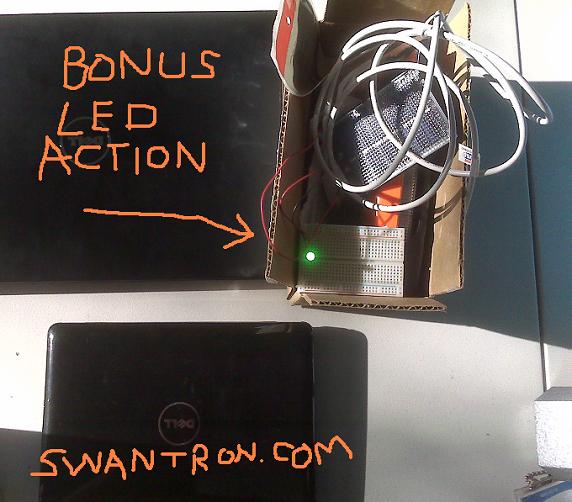 It turns out my florescent lamp was pretty weak…the 7 O’Clock sun put it to shame, in the day-after mess of my ’lab.’ Indirectly awesome. ***ADDITIONAL BONUS MATERIAL*** See if you can spot the following * Netbook * Notebook * Zoot Badge * Solar Panel * USB cord * Table * Cardboard Box * Other Random Electronics Crap Good Luck!
Arduino Solar Cell Input
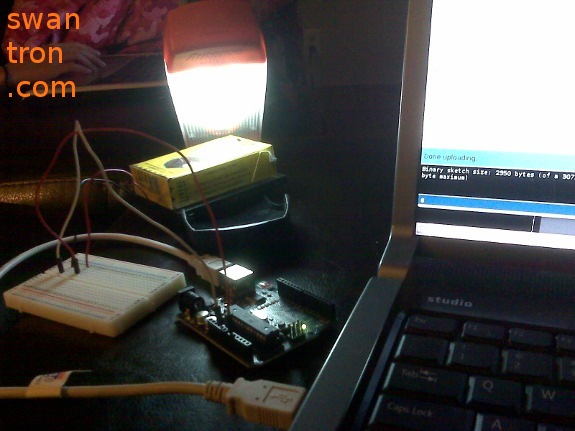
Here we go. As I mentioned a few days ago, I’m horsing around with analog input to my Arduino, in the form of input via a solar cell. For the win. It turns out, that I’m getting far better with my casual electronics experimentation…I will chalk this one up as a win…My basic set-up is this…Radio Shack solar cell, breadboard, florescent light source, Arduino, and a notebook.
Step 1: Gauge light source via multimeter
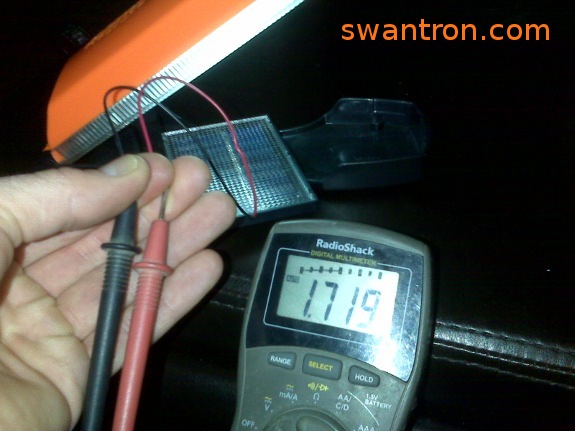 1.7 V…no need to toss in a resister, as the Arduino can handle 5V without issue. Good to go.
Step 2: Interface with Arduino via breadboard
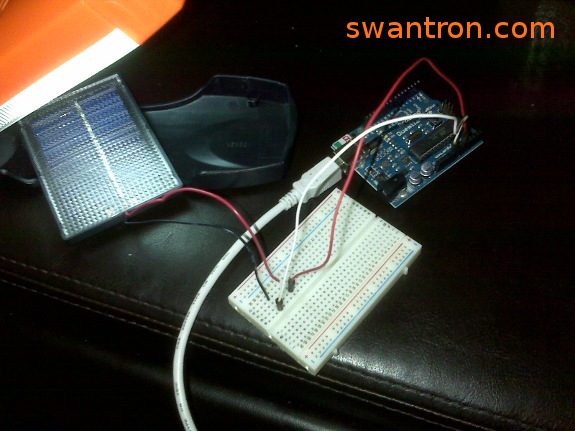 This could have been a direct setup, but for the sake of not soldering a solid lead to my solar cell array, I chose to twist the crap out of the existing + and - leads of the wire outs on the unit, and cram them into the breadboard. USB connected to the Arduino, of course.
Step 3: Chop in some code for the Arduino
This was the tricky part…not that tricky, however:
void setup() {
  Serial.begin(9600);
}

void loop() {
  int v = analogRead(0);
  Serial.print(v);
  Serial.print(' ');
  delay(900);
}
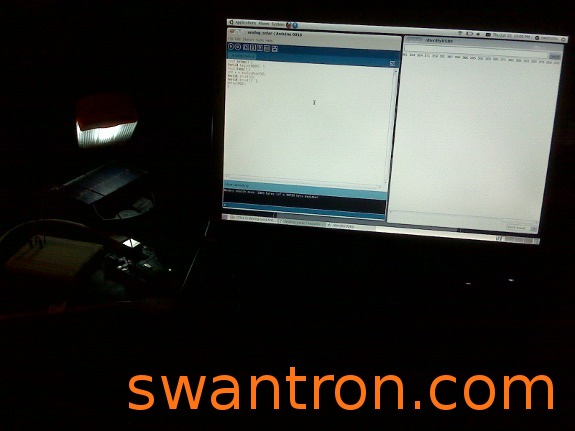
Note the lack of comments? I’m a flipping math dude, so that is wholly optional in my book. Long story short, Wiring is a stripped cousin of C++…I have to void setup and loop here, since I am not concerned with anything once I let ’er rip. I will touch on the programming specifics at a later date, but inquiring minds can find this info quite easily on the Arduino project’s main page, or on Wikipedia. Knock your socks off. I added the delay for sake of real-time monitoring, and matched the baud rate to which I had configured my USB connection. ttyUSB0 would be that in question…9600 would be the rate.
Step 4: Read input via serial monitor
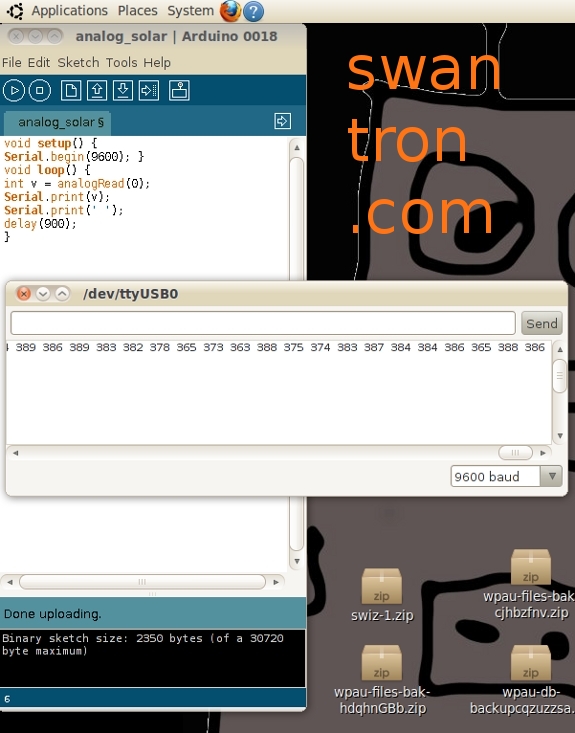 As you can see, it is pretty much constant, with some fluctuation due to my set-up. Noisy, yes. Cheap components, yes.
Step 5: Testing ‘zero’ state
Here, I have employed my box of smokes. American Spirit Lights, to be precise.
Step 6: Gauge system
Here, I’m altering between ‘on’ and ‘off’ states. I start with the ‘off’ (smokes on solar panel) configuration for a time, remove the box to open the system to ‘max input’ for appx 7 secs, and then place the box to remove the input energy.
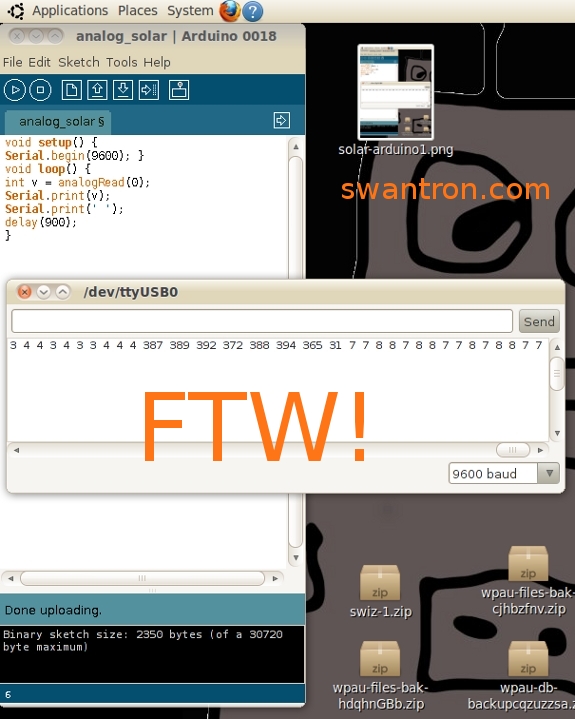
Most definitely for the win…with the experimental noise, that could be considered effectively zero. For the win. In summation, I have read in analog, as intended. Lessons learned? Pretty straight forward I suppose. My cheap-o solar cell is rated for a max of 6V, which I was far under. If I was to use this setup with a stronger light source, I would need to take this into consideration. I didn’t perform any data transformation, as I was not concerned with ‘actual voltage input values’ in this case…merely relative. Most importantly, I was able to knock out the task I had set out to do. Hopefully, I can ride my EE high and get cranking on something awesome, like a netbook robot. With some lasers.
Life Insurance Star
Time for my insurance rant of the week. Another rainy Saturday, another afternoon spent trolling for better insurance. This time: Life Insurance!  I managed to find some pretty slick stuff at LifeInsuranceStar. Not only the normal Life Insurance Quotes, but they had a huge range of reviews and articles, ranking the Best Life Insurance Companies. Trust me, it is not easy to find this type of info in a concise format. Check out Geico…ranks pretty high for life insurance.
 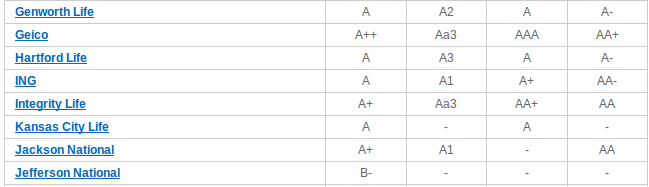 I spent some time checking out the Annuity information. The site itself is slick…made it easy to get wrapped up in my research.
Solar Panel LED Set-up
New project under way… Solar Panel + LED at this point…soon to be solar panel » analog input Spoiler: it is going to be awesome 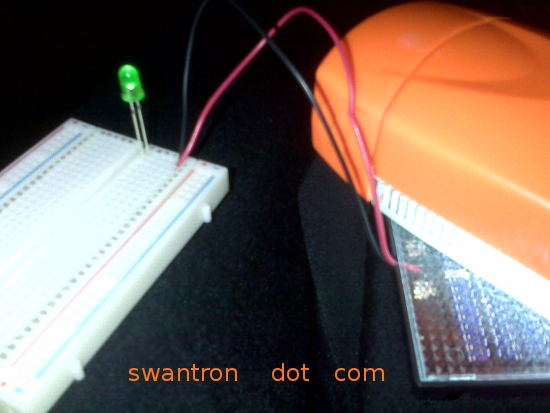 Stay tuned for further details
Remote Desktop Musings
I am a fan of remote computer access. Huge fan, in fact. I use the crap out of it at work on our Windows XP boxes to access the Load and Performance boxes. I too fire upremote access software at home on my Linux machines…primarily to help D-Rock troubleshoot his Ubuntu set-up. Both scenarios have proven to be quite important, and almost a necessity any more.  Whereas my scenarios are quite secure and specific, there exists a need for more secure, wide ranging remote access solutions. How about some 256-bit encryption? Like industry leading [link removed] With a secure system like that, you can troubleshoot other people’s computers remotely, with confidence for both the client and operator. Same is true for work collaboration. The flow of ideas is far easier to channel via a remote connection, be it a single user driving the discussion, or even with multiple users rolling simultaneously. Another use is a little less conventional. You can utilize the remote desktop set-up to act as a file share system. Multiple users, remotely rolling files in and out of a ‘server’ machine remotely via the interwebs. Not too bad of an idea at all, if you ask me. Hit one of those links to read more. I’m going to attempt to remotely access Katie’s notebook, through a remote connection from my netbook, from a remote connection to my notebook. +1 bonus degree of separation
MS Paint Tips
Pomeranians are creepy.  Mad MS Paint skillz. +1 small dog
Found: My Dream Robotics Project
+1 Android +1 Arduino +1 Voice Recognition I found this guy over at engadget…called truckbot, it packs the aforementioned awesome things I love. 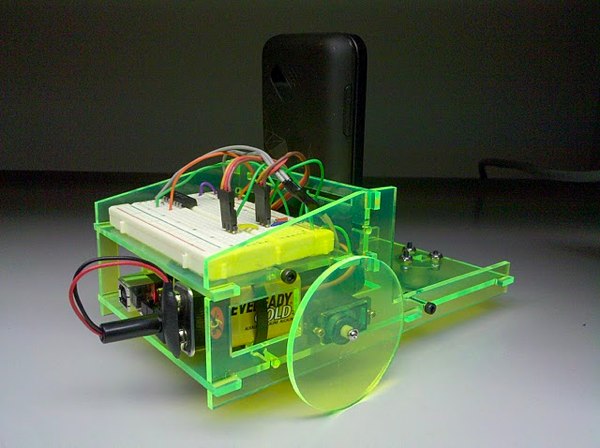 Truckbot is autonomous…the little sucker won’t drive off the edge of a table, even if user prompts it to. This may be a violation of one of Assimov’s robot rules…go look it up. No time to blog…must continue drooling over this.