Unboxed and rooted…  …bloatwear wiped. Going to research ROMs a bit, but will likely be on CGM7.1 in two shakes of a lamb’s tail.
Spidered Screen
We had a great run… 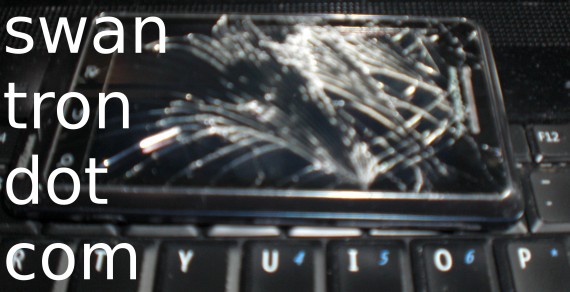 …the old D2 finally met its match. Broken and bruised, the little guy is still working like a champ, bulging battery and all. New phone soon…going to have to figure out how to root Gingerbread I guess.
WWF Royal Rumble
Zig and I have been having some heated Words with Friends battles recently. I had to snap a screenshot of this ridiculous game status… 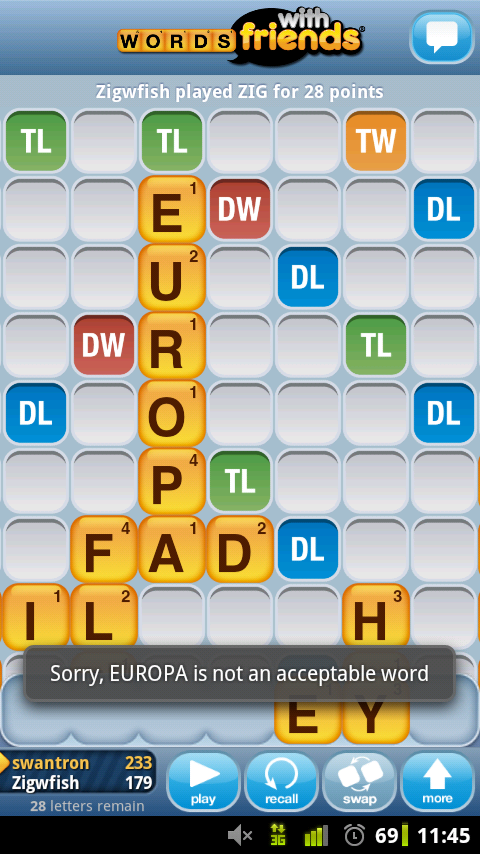 It was bullshit that Ziggy wasn’t awarded more points for playing his handle, and bullshit too that Europa wasn’t an acceptable play. We both got over it. We are pretty evenly matched…I might be ahead by two games. Sad day in Mudville when I am addicted to a Zynga game…too bad the Scrabble app for Android was borderline unusable. Zynga would kill it, score-wise. Mental note.
SOPA Day
I stumbled upon a SOPA protest last night…I first thought Wikipedia had jumped the gun, but realized it was after midnight on the Eastern side of things.  Elsewhere for some entropy info…which will show up shortly in a post. Anyhow, this morning I found some good info on the reddit blog that concisely runs through some technical details of SOPA and PROTECT IP. Take a look…it is important.
Managed Service Provider
So, I’ve been doing this software thing for a while now. It is a strange, strange industry. It is becoming more apparent that every implementation of a generic service ends up falling into a similar life cycle. They all start with an idea, mash together a product, and go to market. The tricky part lies in new features, new connectivity, implementing the product on new technology as it arises, etc. That et cetera is sort of the name of the game. As the playing field changes, the product must too change. To make matters worse, things move at a quicker pace now more than ever. It is pretty shortsighted to assume your product will ever hit a true support phase. When that happens, you are likely no longer a player in your industry. The name of the game is managing your services…  From time to time I check out hosting and virtualization providers on the nets. I stumbled across NCC Data, a [shitty company who bought a link] offers a product that essentially addresses my rant above. The key word is, undoubtedly, manage. Once you hit a certain level of critical mass, you must make the decision weather to support your goods in house (custom code, legacy systems, chopped and screwed…) or take on somebody to hammer out your details. NCC can handle your virtualization, support, security, and the whole other range of hosting headaches. Hit the link to take a look.
RBG LED Controller
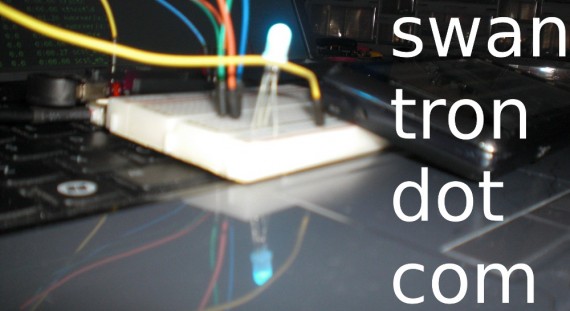
My off-the-cuff remark about building an auxiliary bilirubin light manifested itself into a quick project.
In order to approximate the specific color of the bilirubin lamp, I figured that I would need to provide a means of setting PWM values for the three inputs. I had hard-coded values in Arduino code in the past, so thought about taking that route initially. I blew the dust off my Duemillova, fired up the Arduino IDE, and promptly decided to modify my Java servo PWM code to do the job.
Sort of growing attached to the IOIO…sorry Arduino.
So, the controller was born…IOIORBG.
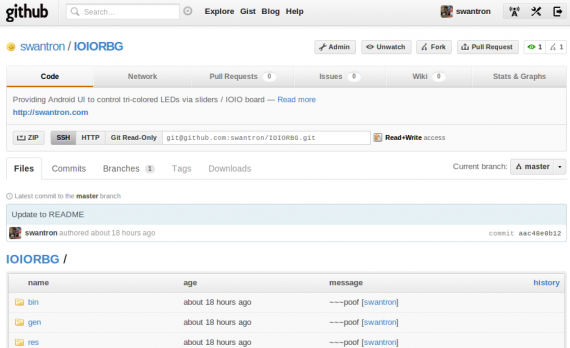
As usual, I posted the code on github…
For testing purposes, I also dumped the apk on the Android Market…
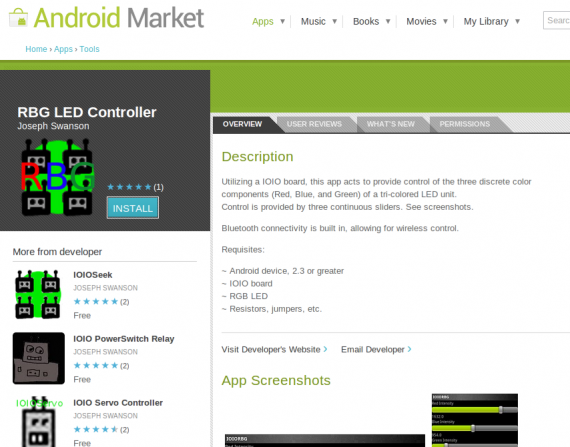
I have some work to do on my descriptions, but the gist of the setup is:
Red - Pin 10 Gnd - Gnd Blu - Pin 11 Grn - Pin 12
Give it a try…I’ll see about ramping up the output for the baby…
Tron Baby
My sidekick is already dabbling in solid state physics…  …namely, the optics around the 440 nanometer range. She is oxidizing some bilirubin into biliverdin. I have a bunch of RBG LEDs on my workbench…maybe I should go slap together an auxiliary biliblanket. DIY neonatal hack…
Sidekick

Android Side Project
Much like the girl has decided to keep at the in-womb thing, I have decided to keep at the Java thing. Little brat. I decided to figure out how to dump accelerometer / orientation data off of the phone, for use with the IOIO. In short, I am roughly attempting to see how the data exists in its natural state, in order to figure out how to scrub and interface with my physical components. 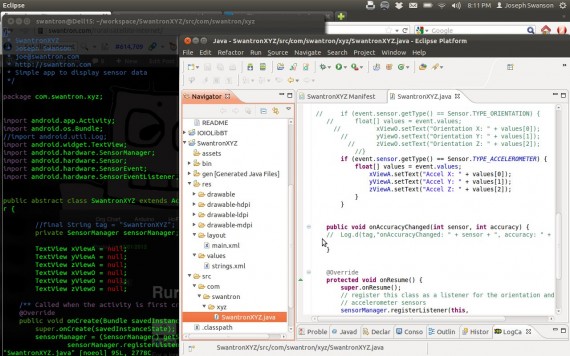 So far, I have nice looking code that blasts a force close scenario. Great. Anyhow, I’m hoping my time on this effort comes to a close and the girl decides to join us. Teamwork…I’ll code, she can practice her singing.
Rural Satellite Internet
For a long while when we buffering used to stream YouTube buffering videos our inter… buffering …net connection used to be sort of buffering OoO buffering OoO buffering lousy. It would randomly stop buffering a movie for several seconds, which does buffering not seem like much of a deal unless you are trying to buffering OoO buffering OoO buffering concentrate on buffering something. Buffering. Well, fortunately for us, our issue was an easy fix. As the technician did the normal technician thing, whereas he checks line levels at the modem and works backwards to the stub in, he (we) found a splice into the neighbor’s place. Must have been an inside deal at some point…an inside deal that would have gone unnoticed a few years ago. Once I moved in and started cranking high speed internet and two digital cable connections on the coaxial, it became a sore thumb. The question of the day is this…what do you do in a place without the physical connections that we have? Are you just s.o.l. and stuck buffering? Nope.  Whereas dial-up connections were the status quo, the future is now here, my friends. Satellite Internet is your answer. It is pretty amazing if you stop to think about it…jumping up to broadband speeds from dial-up, using technology that is superseding that of the cellular industry. Leaps and bounds, when comparing geosynchronous orbit to the height of a cell tower. Think about that. Anyhow, hit that link above to see how a good provider does it. Or buffer…your choice.